Showing posts with label books. Show all posts

Monday

Site-map


[Cover Image: Michael Dean]


This site exists in order to provide a conveniently accessible online index for the New Zealand literary journal brief, founded by Alan Loney in 1995, and carried on (under a succession of editors) until now.

No copyright works have been reproduced here, with the exception of covers and contents pages for the various publications produced by the Writers Group - brief's community of subscribers and contributors - over this period. Some of these works are available elsewhere on the internet, however, and hyperlinks to these locations have been provided wherever possible.

There are individual pages below for the contents of each issue, supplemented by an alphabetical index of the contributions of each author. A short history of brief has also been provided, with a selection of various of the statements and manifestos issued by its editors at different times, as well as a list of the books published to date by the magazine.

For up-to-date information on submission policies, subscription rates, and any other information about the journal, please go to the official website at http://www.briefthejournal.nz; alternatively, you can email the present managing editor, Olivia Macassey, or write to her c/o the following address:
brief
1416 Kaiaua Road
RD 3
Pokeno 2473
New Zealand


Subscription rates:


$NZ 30 for two issues post free in Aotearoa.
$55 for institutional addresses.
$50 for Australia.
$70 elsewhere.
$20 for single issues and back issues.

Please make cheques payable to:
The Writers Group
(address as above)


Upcoming issue:


Call for Submissions to
brief
the magazine formerly known as:
A Brief Description of the Whole World


Brief has re-emerged and is seeking all manner of changes, transformations, alterations, mutations, re-orderings, transfigurations, conversions, variations, reorganizations, evolutions, metamorphoses, modifications, and reconstructions.

Issue 57 will be a general issue (no theme).

Submissions are to be received by the end of October, 2018, and can be emailed to brief.the.journal@gmail.com. Non-electronic submissions up to A4 in size can be mailed to the editor by prior arrangement.


The magazine was founded in December 1995 by Alan Loney. Its format was simple: A4 sheets, copied exactly as their authors wrote them, stapled together, then distributed with bio notes and a cover. Subsequent editors and guest editors of brief since 1999 include John Geraets, Jack Ross, Brett Cross, Bill Direen, Ted Jenner, Jen Crawford, Scott Hamilton, Hamish Dewe, Richard von Sturmer, Bronwyn Lloyd, Michael Arnold, Alex Wild and Olivia Macassey - the current Managing Editor of brief.

Brief is a space for new experimental writing, work that does something interesting, adventurous, challenging, or exploratory. It publishes poetry, prose, essays & criticism, hybrid forms, and occasionally visual art. Contributors receive an issue of the journal as payment. Website: www.briefthejournal.nz.

The present format of brief is A5, perfect-bound, with bio-notes and a card cover, but although the scale is smaller than the original, the magazine continues to adhere to the original policy of reprinting work exactly as it is sent, which enables contributors to pay close attention to the design and layout of their pages.

If you feel your writing fits the brief for brief then our editors will be very pleased to receive your submission.


[Cover Design: Alan Loney]


[Cover Image: Will Maclean]

Books:

  • K. M. Ross. Falling Through the Architect. ISBN 0-476-01578-2. Auckland: The Writers Group, September 2005.

  • Kendrick Smithyman. Campana to Montale: Versions from Italian. Edited by Jack Ross. ISBN 0-476-00382-2. Auckland: The Writers Group, October 2004.

  • Jack Ross. A brief index: A breakdown by issue & author of 7 years / 26 issues of brief, the magazine formerly known as: A Brief Description of the Whole World / ABDOTWW / description / ABdotWW / Ab.ww / brief. &c., December 1995 – January 2003. ISSN 1175-9313. Auckland: The Writers Group, February 2003.

    • --. Supplement 1. A breakdown by issue & author of 3 years / 7 issues of brief ... June 2003 – May 2005. Auckland: The Writers Group, 2005.

  • Sugu Pillay. The Chandrasekhar Limit and Other Stories. Auckland: The Writers Group, December 2002.

  • Alan Loney. Reading / Saying / Making: Selected Essays. Auckland: The Writers Group, 2001.


[Cover Design: Janet Hunt]


Saturday

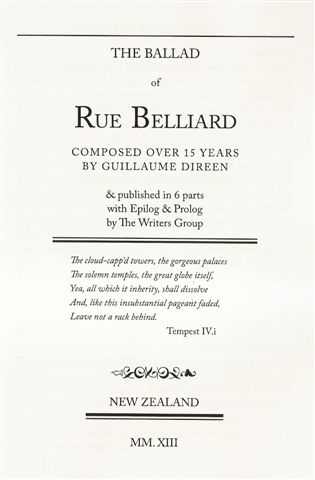
Issue 48 (June 2013): The Ballad of Rue Belliard


[Cover photo: Owen Slatraigh / Cover Design: Ellen Portch]

brief
Editor: Brett Cross
Number 48 (June 2013):


Brett Cross / Editorial / [1]
Guillaume Direen / The Ballad of Rue Belliard / 3


Tuesday

Issue 12 (June 1999): Willy's Gazette


A Brief Description of the Whole World
Editor: John Geraets
Number 12 (June 1999):


John Geraets / Carousel / [2]
Leigh Davis / Willy’s Gazette (1983/99) / 3


Falling Through the Architect


K. M. Ross. Falling Through the Architect. ISBN 0-476-01578-2. Auckland: The Writers Group, September 2005.

Blurb from Crywolf Books:

Welcome to the dark machinery: to a meticulously-detailed Edinburgh in the year 1992, where a Fruitmarket delivery boy is about to take the shop van to an address that appears not to exist at all.

The machine, the random play of hazard, will introduce him into another environment altogether: a sleazy dive of a flat in a tenement block on Causewayside named Rochelle Place.

There Fian, the Buddha-girl, lives a life of pure serenity. There the Australian Steve acquires money by his grey-market dealing in computer parts. There nothing is exactly what it seems: neither the people, nor this environment itself; and the boy through his own unsuspecting openness is quickly drawn in to a cat's cradle of the strangest forces and desires.


And above it all, The Architect moans on, self-proclaimed creator and maintainer of every minutest detail of the process of event, hovering like an unthinkable whale-form in and through and over the universe. YHVH, the Lord, our God – or so he claims.

He tells a frightening story of origins beyond imagination, of the secret origin and motivation of his own act of Creation. Ranting and rhyming away, he builds on hooks and preoccupations from the minds of each of the human characters.


While the relations of Bob and Fian and Steve build from crisis to crisis, from sex to violence to mental breakdown, we have to wonder: where are these God-texts coming from? Are they someone's black tormented dream? ... Or some psychological weaving-together, the roar of the composite?

... Or could this be the voice of the machine itself, that great Design, so huge that its relevance is not to humans, through which they tumble helplessly like a race of pinballs, fortuitously clashing and connecting and falling away again?

We are falling, falling, through vectors, frighteningly precise — drawn by what kind of hand?


Reviews & Comments:

  1. Bill Direen, "Falling or Flying: Review of Falling Through the Architect." brief 35 - A brief world order (2007): 103-4. [Available at: Reading the Maps (4 May 2007)]:

    As printed characters rely for meaning on the space immediately around them and upon other characters among which they exist in a work, Falling through the Architect realises its central narrative by means of oscillating but complementary narratives (or “anti-narratives”).

    We are continually reminded of the novel’s textual nature: the ‘story’ in plain font is counterpoised by an unidentified voice in bold font which, as the boldness of the font accentuates, reads as a kind of tirade.

    A "plain" narrative depicts the intersecting life-stories of several persons, into whose minds the writer enters at will. There is an accessible realism here. This is a story full of hard social facts, which relies on a careful geography inseparable from its erotic subterfuge. On the social front alone it is a valuable reflection of current Edinburgh mores and language usage. The “Scottishness” of the terrain is neatly blurred by the city's multi-cultural element, while the diversity of its inhabitants is unified by the acquired “Scots” of some of their dialogue (and the author’s deftness in this area). The street-plans and the plans of the interiors are particularly detailed and necessarily so, since, as we read, as we become more intimate with the text, physical reality becomes less physical! The eroticism, overtly heterosexual, ranges from battering roughness to mysterious finger signals or catastrophic onanism, and is present at various levels, sometimes violent.

    The "bold" tirade draws on many sources — mystical, lyrical and musical. Its nature was not, at first, clear to me. I wanted to know how the alternating sequences related to each other, and what the ultimate design of the author was. Soon, questioning itself began to take on the form of an answer. After trying multiple-choice (‘Is the tirade the voice of more than one character, of a combined god-author character, or of a single fictional multi-facetted entity or design?’) I tried letting go all preconceived notions of ‘voice’ and allowed the tirade to issue from a sort of Negativeland, an alternative time-space continuum which, like the white between the ink of the text, rubs up against everyday lives, the hard-copy of our primary stories. And then...?

    Then K.M Ross really began to fly!.


Campana to Montale: Versions from Italian


Kendrick Smithyman. Campana to Montale: Versions from Italian. Edited by Jack Ross. ISBN 0-476-00382-2. Auckland: The Writers Group, October 2004.

Contents:

Introduction

Dino Campana

Born in 1885, near Faenza; died of septicaemia at Castel Pulci in 1932. Before being committed in 1918 to the mental hospital where he died, Campana’s life was characterised by compulsive wandering, tormented love affairs, and extreme disdain for the literary establishment. Major work: Canti Orfici (1914).
Old Florence
Firenze vecchia
from The Evening of the Fair
La sera di fiera
Campana in an Autumn Garden
Giardino autunnale
Woman of Genoa
Donna genovese
The Skylight
L’invetriata


Sandro Penna

Born in Perugia in 1906; died in Rome in 1977. A somewhat isolated figure in modern Italian poetry, Penna is generally described as the one working-class poet among the intellectuals of the Hermetic school. Major works: Tutte le poesie (1970); Stranezze (1976).
untitled
‘Esco dal mio lavoro …’
untitled
‘Il treno tarderà …’The Journey
Il viaggio
untitled
‘Tutto il giorno passai …’untitled
‘Con il cielo coperto …’Morning
Mattinountitled
‘L’ombra di una nuvola …’
untitled
‘Alfio che un treno Porta …’
untitled
‘Voglio credere ancora …’
untitled
‘Lungo è il tragitto ...’untitled
‘Viaggiava per la terra …’
In a Small Venetian Square
La veneta piazzetta
untitled
‘Lasciami andare ...’
untitled
‘Sulla riva del fiume …’untitled
‘Sole con luna …’
untitled
‘Se desolato io cammino ...’
untitled
‘Nel chiuso lago …’
Woman in a Tram
Donna in tram
untitled
‘Sul campo aperto …’
untitled
‘Imbruna l’aria …’
News of Spring
Cronache di primavera
untitled
‘Forse sull’erba verde …’


Nelo Risi

Born in Milan in 1920. A qualified doctor, but writer by vocation, he spent most of World War II in Russia, and was subsequently interned in Switzerland. His work concerns itself mainly with “the dilemma of the individual in an age of mass-consciousness.” Major works: L’esperienza (1948); Il mondo in una mano (1994).
Mister Risi: The Poet
Il poeta
Risi’s Tautology
TautologiaRisi Says Muses Played Out
Le muse sono stanche


Giuseppe Ungaretti

Born in Egypt, at Alexandria, in 1888; died in Milan in 1970. He served as an infantryman in World War I, an experience which confirmed him in his vocation as a poet. With Montale and Quasimodo, one of the “big three” of twentieth-century Italian poetry. Major work: Vita d’un uomo (1969).
Quiet / Quietus
Quiete
Evening
Sera
Nostalgia
Nostalgìa
The Vigil of Ungaretti
Veglia
Agony
AgoniaUngaretti’s Drowned Port
Il Porto sepolto


Leonardo Sinisgalli

Born in Montemurro in 1908; died in Rome in 1981. His background in physics and graphic design led him to formulate a poetry of detached understatement, in opposition to the frenzied aesthetics of his contemporaries. Major works: Cuore (1927); 18 Poesie (1935).
Children Tossing Red Coins
I fanciulli battono le monete rosse
How Sr Sinisgalli Eyeballed the Muses
Vidi le Muse


Alfonso Gatto

Born in Salerno in 1909; died in a road accident near Orbetello in 1976. He was imprisoned in Milan in 1934 for opposition to the Fascist regime, and was active in the Resistance during World War II, experiences which informed much of his later poetry. Major works: Poesie (1941); La madre e la morte (1960).
For the Martyrs of Loreto Square
Per i martiri di Piazzale Loreto


Vittorio Sereni

Born in Luino, Lago Maggiore, in 1913; died in Milan in 1983. Fought as an infantry officer in Greece and Sicily, where he was taken prisoner. His initial adherence to Hermeticism was succeeded by a more realistic approach to war and post-war austerity. Major works: Diario d’Algeria (1947); Stella variabile (1981).
Vittorio Sereni’s First Night out from Athens
Prima sera d’Atene
Airborne
Non sa piú nulla
At Six in the Morning
Le sei del mattino
Vittorio Sereni and His Great Friend
Il grande amico


Camillo Sbarbaro

Born in Santa Margherita, Liguria, in 1888; died at Spoleto in 1967. Generally seen as an adherent of the turn-of-the-century Crepuscular school, Sbarbaro’s melancholic self-absorption in fact has more in common with later poets of disillusionment such as Montale or Eliot. Major works: Pianissimo (1914); Rimanenze (1956).
Now You Have Come
Ora che sei venuta
La bambina che va sotto gli alberi


Luciano Erba

Born in Milan in 1922. Scholar, translator and critic, Erba’s elaborately ironic undercutting of traditional poetic language and attitudes have helped him to build up a biting commentary on post-war Italian values. Major works: Il prato più verde (1970); Il nastro di Moebius (1980).
Luciano Erba in Lombardo-Veneto
Lombardo-Veneto
Luciano Erba Entertaining Them
Lo svagato


Mario Luzi

Born in Castello, near Florence, in 1914. An early exponent of the hermetic movement, whose motto “letteratura come vita” [literature as life] dominated Italian literature in the 1930’s, his later work is less liable to assume the capacity of poetry to palliate suffering. Major works: La barca (1935); Tutte le poesie (1979).
Mario Luzi: But Where
Ma dove
Mario Luzi on Judging
Il giudice
From (Mario Luzi) One to Another
L’uno e l’altro


Giorgio Orelli

Born in Airolo in 1921. He studied Italian literature with Gianfranco Contini at Fribourg, then went to teach in Bellinzona, where he has been living since 1945. He is onsidered by many the greatest poet of Italian Switzerland. Major works: Poesie (1953); Sinopie (1977).
The Trout
La trota


Elio Pagliarani

Born in Viserba, near Rimini, in 1927. Teacher, editor, journalist, Pagliarini’s poetry attempts to replace the conventions of the Romantic lyric with a neo-realist but linguistically complex presentation of the lives of ordinary people. Major works: La ragazza Carla e altre poesie (1962); Lezione di fisica e fecaloro (1968).
from The Girl Carla
La ragazza Carla


Lucio Piccolo

Born 1903 in Palermo. Died in 1969 at his Sicilian property at Capo d’Orlando. Like his more famous cousin Tomasi di Lampedusa, lived out of the mainstream of Italian cultural life. Major works: Canti barocchi (1956); Plumella (1967).
Lucio Piccolo’s Days
I giorni


Eugenio Montale

Born in Genoa in 1896; died in Milan in 1981. His poetry, perhaps the most influential in twentieth-century Italian literature, constantly circles back to his childhood on the coast of Liguria. Largely self-educated, he lost his job as an editor in 1938 as a result of anti-fascist opinions, and supported himself afterwards with occasional journalism and translation. Major works: Ossi di seppia (1925); Le occasioni (1939); La bufera ed altro (1956); Satura (1971).
Promenade by the Sea
Lungomare
untitled
‘Portami il girasole ...’
Intermezzo
IntermezzoThe Customs Officers’ House
La casa dei doganieri
The Eel
L’anguillauntitled
‘Un tempo …’
Honour
L’onore
When I Began to Paint
‘Quando cominciai a dipingere …’After the Rain
Dopopioggia
Heroism
L’eroismo
Reading Cavafy
Leggendo Cavafis
Disguises
I travestimenti
A Poet
Un poeta
On The Lake Of Orta
Sul lago d’Orta
In the Negative
In negativo
Culture
La cultura
In a Northern City
In una città del nord
The Inhuman
Nel disumano
A Dream, One of Many
Un sogno, uno dei tanti
That Woman from the Lighthouse
Quella del faro
From the Other Side
Dall’altra sponda
On the Beach
Sulla spiaggia
untitled
‘Si aprono venature pericolose ...’
Aspasia
Aspasia
A Letter Not Sent
Una lettera che non fu spedita
untitled
‘Oltre il breve recinto …’

Salvatore Quasimodo

Born in Modica in 1901; died in Milan in 1968. His Nobel prize for literature in 1959 was awarded mainly for the wartime poems collected in Giorno dopo giorno [Day after day] (1943-46), an advance on the austere Hermeticism of much of his early work. The life of the Sicilian countryside and the classical Mediterranean past are two interests which constantly resurface in his poetry. Major works: Ed è subito sera (1943); Tutte le poesie (1960).

from Acque e terre (1920-1929)

Your Dress is White
E la tua vesta è bianca
Deadwater
Acquamorta
Winter in the Old Days
Antico inverno
Sorrow of Things I Don’t Know
Dolore di cose che ignoro
The Dead
I morti
Alley
Vicolo
Refuge of the Birds of Night
Rifugio d’uccelli notturni

from Ã’boe sommerso (1930-1932)

Sunken Oboe
Ã’boe sommerso
To My Land
Alla mia terra
Word
Parola
Of a Young Woman Lying Back among Flowers
Di fresca donna riversa in mezzo ai fiori
Lamentation of a Friar in an Icon
Lamentazione d’un fraticello d’icona
Without Memory Of Death
Senza memoria di morte
Prayer to the Rain
Preghiera alla pioggia
Woods Sleep
Dormono selve
To Night
Alla notte
Metamorphoses in the Saint’s Urn
Metamorfosi nell’urna del santo
Island
Isola
Where the Dead Stand Open-Eyed
Dove morti stanno ad occhi aperti
The Angel
L’angelo
Water Decomposes Dormice
L’acqua infradicia ghiri
Seed
Seme
First Day
Primo giorno
Green Drift
Verde deriva

from Erato e Apòllion (1932-1936)

Apollyon’s Song
Canto di Apòllion
Apollyon
Apòllion
Dead Heron
Airone morto
On the Hill of the “Terre Bianche”
Sui colle delle “Terre Bianche”
In Your Light I am Wrecked
Al tuo lume naufrago
Insomnia
Insonnia
Often a Shoreline
Sovente una riviera
Ulysses’ Isle
Isola di Ulisse
Salt-Pan in Winter
Salina d’inverno
Sardinia
Sardegna
In Light of the Skies
In luce di cieli
Quarries
Latomìe
For My Mortal Smell
Del mio odore di uomo
Stranger City
Città straniera
In the Feeling of Death
Nel senso di morte

Nuove Poesie (1936-1942)

The Magpie Laughs, Black in the Orange Trees
Ride la gazza, nera sugli aranci
A Street in Agrigentum
Strada di Agrigentum
The Gentle Hill
La dolce colline
What are You up to, Shepherd of Air?
Che vuoi, pastore d’aria?
Before the Statue of Ilaria del Carretto
Davanti al simulacro d’llaria del Carretto
Now Day Breaks
Ora che sale il giorno
The Rain is Already with Us
Già la pioggia è con noi
One Evening, the Snow
Una sera, la neve
The Piazza Fontana
Piazza Fontana
The Tall Ship
L’alto veliero
Elegy for the Dancer Cumani
Elegos per la danzatrice Cumani
Delphic Woman
Delfica
Imitation of Joy
Imitazione della gioia
Moon Horses and Volcanoes
Cavalli di luna e di vulcani
Once More a Green River
Ancora un verde fiume
Beach at St Antiochus
Spiaggia a Sant’Antioco
The Scrawny Flower is Already Flying
Già vola il fiore maoro
Verging on Puberty
Inizio di pubertà

Giorno dopo giorno (1947)

Speaking about Willow Branches
Alle fronde dei salici
Letter
Lettera
19 January 1944
19 gennaio 1944
Snow
Neve
Day after Day
Giorno dopo giorno
Perhaps the Heart
Forse il cuore
Winter Night
La notte d’inverno
Milan, August 1943
Milano, agosto 1943
The Wall
La muraglia
O My Sweet Animals
0 miei dolci animali
Written Perhaps on a Tomb
Scritto forse su una tomba
Pilgrim
A me pellegrino
From the Rock Fortress of Upper Bergamo
Dalla rocca di Bergamo alta
Beside the Adda
Presso l’Adda
I Have Heard the Sea Again
S’ode ancora il mare
Elegy
Elegia
Of Another Lazarus
Di un altro Lazzaro
The Crossing
Il traghetto
Your Silent Foot
Il tuo piede silenzioso
Man of My Time
Uomo del mio tempo

from La vita non è sogno (1946-1948)

Lament for the South
Lamento per il Sud
Epitaph for Bice Donetti
Epitaffio per Bice Donetti
Colour of Rain and Iron
Colore di pioggia e di ferro
Almost a Madrigal
Quasi un madrigale
Italy is My Country
Il mio paese è l’Italia
Thànatos Athànatos
Thànatos Athànatos

from Il falso e vero verde (1949-1955)

The Dead Guitars
Le morte chitarre
False and True Green
Il falso e vero verde
In a Distant City
In una città lontana
How Long a Night
Che lunga notte
Beyond the Waves of the Hills
Al di là delle onde delle colline
Near a Saracen Tower, for His Dead Brother
Vicina a una torre saracena, per il fratello morto
Laude, 29 April 1945
Laude, 29 Aprile 1945
To a Poet Not Well Disposed
A un poeta nemico

from La terra impareggiabile (1955-1958)

Visible, Invisible
Visibile, invisibile
The Incomparable Earth
La terra impareggiabile
Today, the Twenty-First of March
Oggi ventuno marzo
From Disfigured Nature
Dalla natura deforme
An Open Arc
Un arco aperto
A Copper Amphora
Un’anfora di rame
The Scaliger Tombs
Le arche scaligere
In This City
In questa città
Once More about Hell
Ancora dell’inferno
Almost an Epigram
Quasi un epigramma
Soldiers Crying in the Night
I soldati piangono di notte
At Night on the Acropolis
Di notte sull’Acropoli
Mycenae
Micene
Following the Alpheus
Seguendo l’Alfeo
Delphi
Delfi
Marathon
Maratona
Minotaur at Knossos
Minotauro a Cnosso
Eleusis
Eleusi
To the New Moon
Alla nuova luna
An Answer
Una risposta
Another Answer
Altra risposta
Inscription for the Partisans of Valenza 1957
Epigrafe per i Partigiani di Valenza

from Dare e avere (1966)

Debit and Credit
Dare e avere
Varvàra Alexandrovna
Only If Love Stabs You
Solo che amore ti colpisca
A Night in September
Una notte di settembre
Along the Isar
Lungo l’Isar
From the Shores of Lake Balaton
Dalle rive del Balaton
Tollbridge
Tollbridge
The Negro Church at Harlem
La chiesa dei negri ad Harlem
Cape Caliakra Capo
Caliakra
Silence Does Not Mislead Me
Il silenzio non m’inganna
Glendalough
Glendalough
The Bowmen Of Tuscany
Balestrieri toscani
In Chiswick Cemetery
Nel cimitero di Chiswick
The Maya at Mérida
I Maya a Mérida
Love Poem
Poesia d’amore
I Have Lost Nothing
Non ho perduto nulla
To Liguria
Alla Liguria
To Keep The World In Balance
Basta un giorno a equilibrare il mondo
I Have Flowers and by Night I Call on the Poplars
Ho fiori e di notte invito i pioppi


A brief index


Jack Ross. A brief index: A breakdown by issue & author of 7 years / 26 issues of brief, the magazine formerly known as: A Brief Description of the Whole World / ABDOTWW / description / ABdotWW / Ab.ww / brief. &c., December 1995 – January 2003. ISSN 1175-9313. Auckland: The Writers Group, February 2003. 48 pp.


Jack Ross. Supplement 1. A breakdown by issue & author of 3 years / 7 issues of brief, the magazine formerly known as: A Brief Description of the Whole World / ABDOTWW / description / ABdotWW / Ab.ww / brief. &c., June 2003 – May 2005. Auckland: The Writers Group, 2005. 20 pp.


The Chandrasekhar Limit and other stories


Sugu Pillay. The Chandrasekhar Limit and other stories. ISBN: 0-473-08731-6. Auckland: The Writers Group, December 2002.

Contents:

Acknowledgements
Foreword (by Lydia Wevers)
The Chandrasekhar Limit
Of Prawns and Poems
Madam Taoist Butterfly
The Daughters of Kunti
Heretic Loka
My Guru My Car
The Word Pitcher
The Lungs of the Globe
Lovers Discourse


Reading / Saying / Making: Selected essays


Alan Loney. Reading / Saying / Making: Selected Essays. ISBN: 0-473-07628-4. Auckland: The Writers Group, 2001.

Contents:

Reading
1997 / Who are poets for?
1996 / Defamiliarizing the familiars
1996 / the path of the text
1996 / The riddle's answer to itself
1995 / On clarity
1992 / The avenues are never closed
1986 / New Zealand poetics and 'America'
1981 / Notes on Joanna Paul's Unwrapping the body
1977 / On being a New Zealand poet

Saying
2000 / entitled / unentitled: New Zealand poetry
1983 / Talking with Leigh Davis
1997 / Parallax revisited
2000 / Waiting to die
2000 / Power and the Scandal of Editing: the Case for A Brief Description of the Whole World

Making
1979 / Printing with the handpress
1986 / Book design in the computer age
1992 / Fine printing and literature - can they live together?
1993 / Prelude to Caxton press typography in the 1950s
1995 / Typography & the great New Zealand pop-up poetry canon
1996 / Edgar Mansfield's bindings
Acknowledgements


Books:


  1. Bill Direen. The Ballad of Rue Belliard. Introduction by Brett Cross. brief 48 (June 2013). ISSN 1175-9313 / Auckland: The Writers Group, 2013.


  2. K. M. Ross. Falling Through the Architect. ISBN 0-476-01578-2. Auckland: The Writers Group, September 2005.


  3. Kendrick Smithyman. Campana to Montale: Versions from Italian. Edited by Jack Ross. ISBN 0-476-00382-2. Auckland: The Writers Group, October 2004.


  4. Jack Ross. A brief index: A breakdown by issue & author of 7 years / 26 issues of brief, the magazine formerly known as: A Brief Description of the Whole World / ABDOTWW / description / ABdotWW / Ab.ww / brief. &c., December 1995 – January 2003. ISSN 1175-9313. Auckland: The Writers Group, February 2003.


    • --. Supplement 1. A breakdown by issue & author of 3 years / 7 issues of brief ... June 2003 – May 2005. Auckland: The Writers Group, 2005.


  5. Sugu Pillay. The Chandrasekhar Limit and other stories. Auckland: The Writers Group, December 2002.


  6. Alan Loney. Reading / Saying / Making: Selected Essays. Auckland: The Writers Group, 2001.


  7. Leigh Davis. Willy's Gazette. 1984. Introduction by John Geraets. A Brief Description of the Whole World 12 (June 1999). ISSN 1175-9313 / Auckland: Jack Books, 1999.


Preface


Let’s begin with some basic details. The Writers Group, and its quarterly magazine A Brief Description of the Whole World (now brief) were founded in December 1995 by Alan Loney. Now, some twenty-odd years later, we’ve reached issue #54, albeit with five changes of name, and seven different managing editors: Alan Loney (1995-98), John Geraets (1999-2002), Jack Ross (2002-05), Scott Hamilton (2005-07), Brett Cross (2007-9), Michael Arnold (2009-12), Alex Wild (2013-15) and now Olivia Macassey (2016- ).

In that time, the magazine has published over 333 authors & artists in 53 issues -- 10/11, 30/31 & 44/45 were double issues, and numbers 12 & 48 were single book-length issues. The Writers Group has also published five books: Alan Loney’s Reading / Saying / Making: Selected Essays (2001), Sugu Pillay’s The Chandrasekhar Limit and other stories (2002), Jack Ross's A brief Index (2003 / Supplement 1, 2005), Kendrick Smithyman’s Campana to Montale: Versions from Italian (2004) and K. M. Ross’s novel Falling through the Architect (2005).

As it has throughout this period, the magazine continues to specialise in technically adventurous literary and graphic work, by acknowledged (and newly discovered) innovators. Pageworks, critical articles, poems and fictional texts are all equally welcome.

Enquiries are welcome, and can be directed to the present managing editor, Olivia Macassey, by email, or by post to the following address:

brief
1416 Kaiaua Road
RD 3
Pokeno 2473
Auckland
New Zealand


Sunday

Contents:


Books:

  • K. M. Ross. Falling Through the Architect. ISBN 0-476-01578-2. Auckland: The Writers Group, September 2005.

  • Kendrick Smithyman. Campana to Montale: Versions from Italian. Edited by Jack Ross. ISBN 0-476-00382-2. Auckland: The Writers Group, October 2004.

  • Jack Ross. A brief index: A breakdown by issue & author of 7 years / 26 issues of brief, the magazine formerly known as: A Brief Description of the Whole World / ABDOTWW / description / ABdotWW / Ab.ww / brief. &c., December 1995 – January 2003. ISSN 1175-9313. Auckland: The Writers Group, February 2003.

    • --. Supplement 1. A breakdown by issue & author of 3 years / 7 issues of brief ... June 2003 – May 2005. Auckland: The Writers Group, 2005.

  • Sugu Pillay. The Chandrasekhar Limit and Other Stories. Auckland: The Writers Group, December 2002.

  • Alan Loney. Reading / Saying / Making: Selected Essays. Auckland: The Writers Group, 2001.